Cut-in
A vehicle in the next lane, 10 m ahead of the ego, changes into the ego's lane 2 s into the run. The ego must not hit it -- on every lane with a lane on that side.
# Every case on the map, one run each
uv run scenario --multirun hydra/sweeper=lanelet_constraint \
    scenario=cut_in/left map=<map>
Scenario
| Ego | Constraint search: a lane with a lane on the cut-in side, not in a junction, at least 60 m long, excluding the map's lanelets with no 3D model. 5 m along it, 30 km/h. |
| NPC1 | Beside the matched lanelet, on the cut-in side: the lane next to the ego's. 15 m along it, 30 km/h. |
| Initialization | Every traffic light green. |
| NPC1, after 2 s | Change lane towards the ego. |
| Pass | 3 s have passed since NPC1 reached the ego's lane -- the matched lanelet or one of the lanelets that follow it before the first junction, the lanes ahead below short of the junction, whose lanelets overlap the lane beside's (npc_in_lanes_ahead) -- with no collision. |
| Fail | The ego collides with anything -- NPC1, another actor, a static object, map geometry such as a wall or a kerb (ego_collided); the ego's centre is on none of the lanes ahead of it -- the matched lanelet and the lanelets that follow it, up to 1000 m from its start -- for 0.2 s: it changed lanes, turned onto a lanelet that does not follow it, or left the road (ego_left_its_lane); or 20 s pass. |
Variants
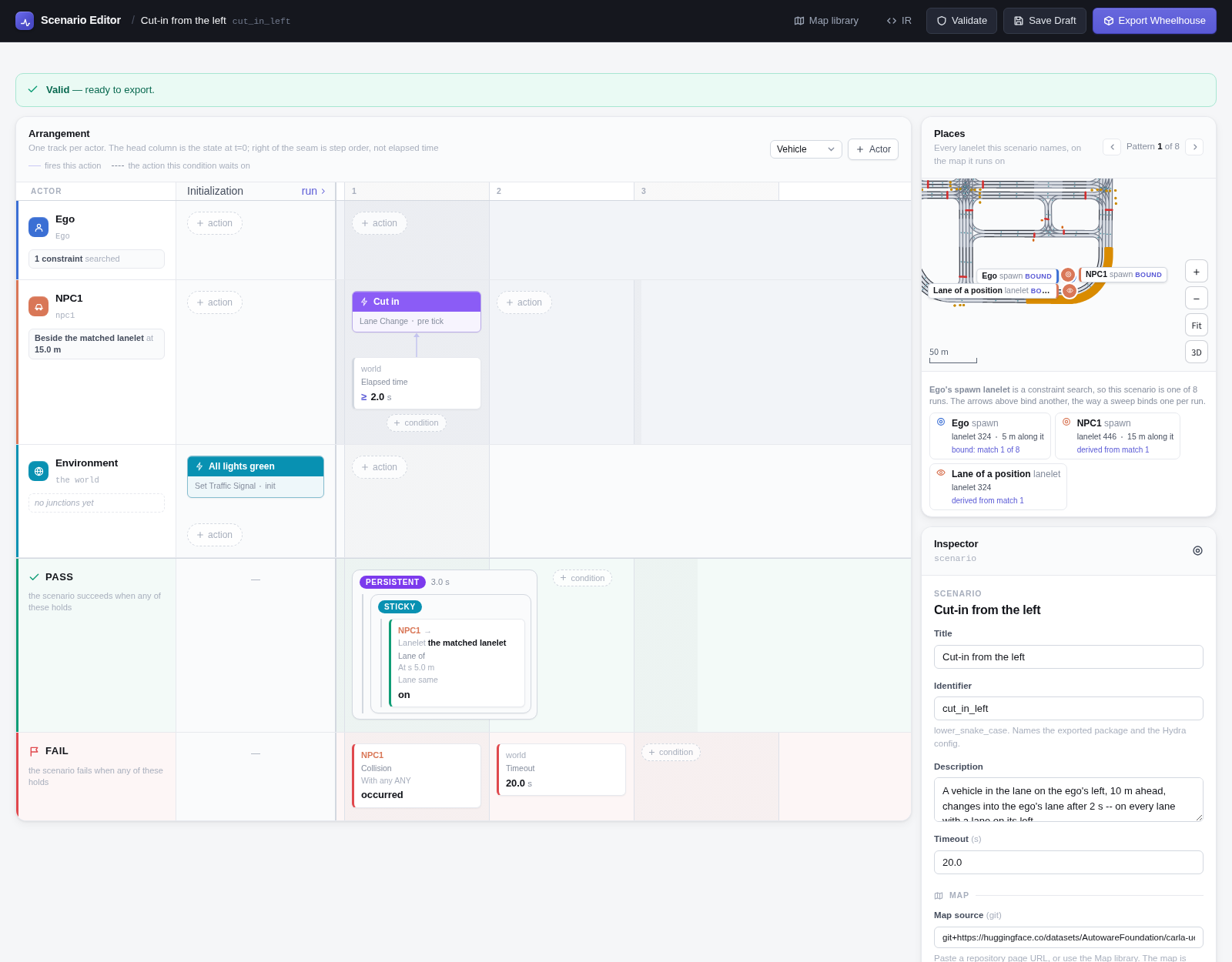
scenario=cut_in/left -- a lane on the ego's left; NPC1 changes right.
Town10HD_Opt, the first case: the search matched lanelet 324, where the ego starts; NPC1 starts beside it on lanelet 446. Result: PASSED.
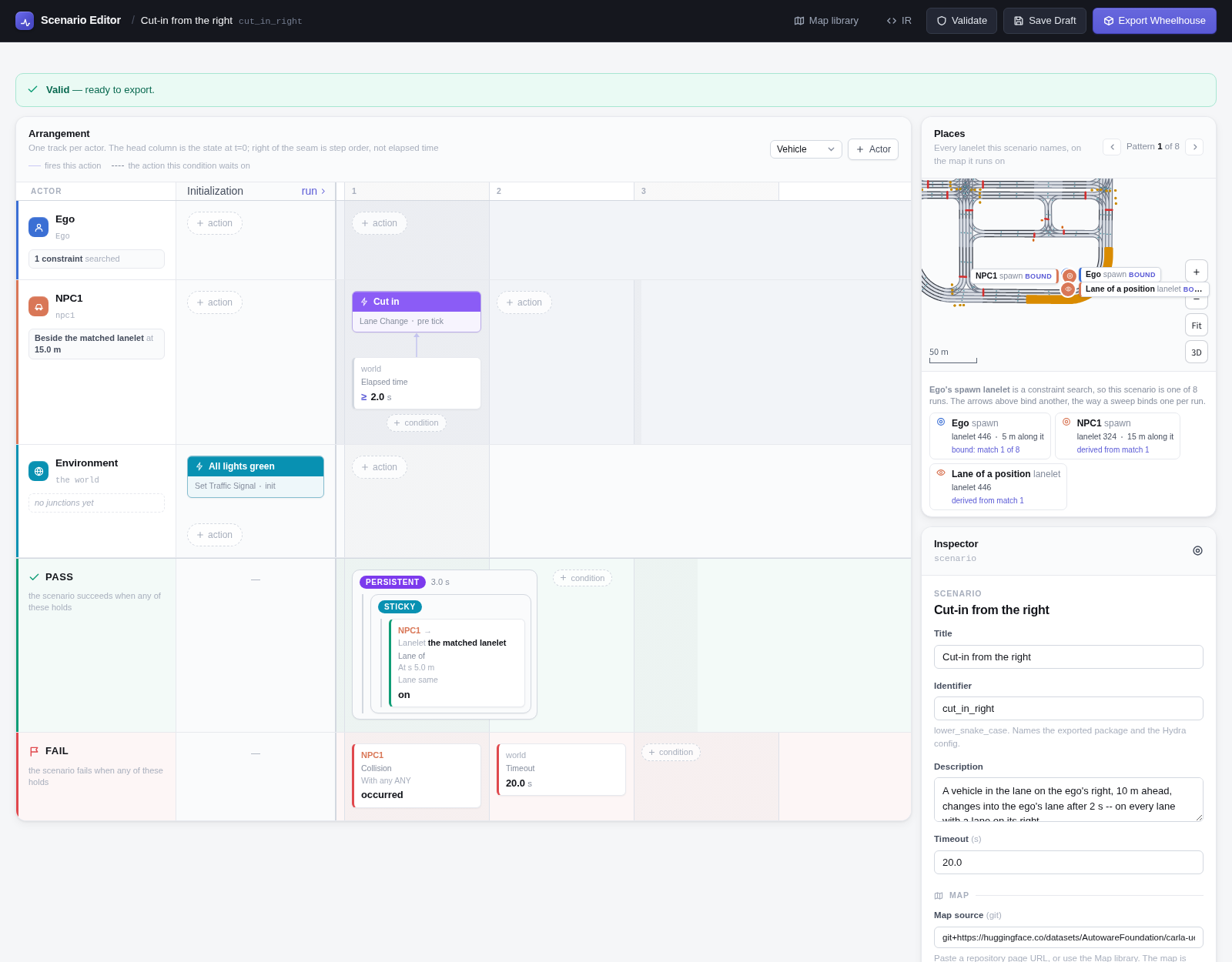
scenario=cut_in/right -- a lane on the ego's right; NPC1 changes left.
Town10HD_Opt, the first case: the search matched lanelet 446, where the ego starts; NPC1 starts beside it on lanelet 324. Result: PASSED.
Parameters
| Parameter | Value |
|---|---|
| NPC1 ahead of the ego | 10 m along its lanelet (at s = 15 m): npc_ahead_m |
| or, measured | npc_gap_m: the gap vehicle_ahead_gap_m reads at the start (bumper to bumper, along the ego's lane); NPC1's s is solved for so it does. Unset by default; an ODD-sampled sweep sets it, 2-30 m |
| NPC1 and ego initial speed | 30 km/h |
| Cut-in after | 2 s |
| Held in the ego's lane for | 3 s |
| Lanelet at least | 60 m |
| Timeout | 20 s |
| Fail on any collision of the ego | on: fail_on_any_collision (off: only a collision with NPC1, hit_cut_in_vehicle) |
| Fail on leaving the lanes ahead | on: fail_on_leaving_lane |
| The lanes ahead reach | 1000 m from the start of the matched lanelet: lanes_ahead_m |
| Off them for | 0.2 s: leaving_lane_seconds (0: the first tick off) |
Staying on the lanes ahead
The ego is to keep its lane while NPC1 cuts in: braking, or slowing, is the
answer the scenario is after, and a run that swerved into the next lane or off
the road has not passed it, whatever it did not hit. The lanes ahead are the
lanelet the ego spawns on and the ones that follow it in the routing graph
(lanelets_ahead: following without lane changes, every branch, up to
lanes_ahead_m); in none of them is in the lane beside, on a lanelet that
turns off them, or in no lanelet at all. Following every branch, those can
loop round a block into the lane beside the ego's, so a lanelet beside one of
the lanes up to the first junction (lanes_ahead_before_junction; the
routing graph's left, right, adjacentLeft and adjacentRight) is left
out when they reach it only past the end of the lanelet it is beside -- never
one of those lanes itself, nor a turn through the junction ahead that ends
beside one of them (ego_lanes_ahead).
It is not a condition of its own but a composition of the framework's,
left_lanes_ahead in examples/cut_in.py, which any scenario can build the
same way:
on_lanes = [
    EntityLanePositionCondition(
        EGO_ROLE_NAME, Lanelet2Pose(lanelet_id=i, s=0.0), label=f"ego_on_lanelet_{i}"
    )
    for i in ego_lanes_ahead(spawn.lanelet_id, 1000.0)
]
self.register_fail_condition(
    PersistentCondition(                     # off them for 0.2 s, not one tick at a seam
        NotCondition(                        # on none of them -- off the road included
            OrCondition(on_lanes),           # on one of them
            holds_when_pending=True,
        ),
        0.2,
        label="ego_left_its_lane",
    )
)
holds_when_pending=True is what makes it a logical NOT. A condition that has
not fired returns nothing, and a plain NotCondition only flips the verdict of
a child that has, so it could not say "on none of these". The position tested
is the vehicle's centre (its CARLA location), so a wheel over the line is not
leaving the lane; a seam between two lanelets is covered by the next one, and
the 0.2 s wait absorbs a tick that falls between them.
A scenario document says the same with the editor's cards -- Persistent, NOT (with Holds while the child does not), ANY and one Position (Lanelet2) per lanelet:
- type: persistent
  params: {duration: 0.2}
  children:
    - type: not
      params: {holds_when_pending: true}
      children:
        - type: any
          children:
            - {type: entity_lane_position, params: {entity: ego, lanelet_id: 79016}}
            - {type: entity_lane_position, params: {entity: ego, lanelet_id: 79017}}
Placing NPC1 by the measured gap
npc_ahead_m is a raw setting: NPC1's s on its lanelet less the ego's on
its own. It is not the gap the vehicle_ahead_gap_m measure reads: the
measure is bumper to bumper -- NPC1's rear bumper less the ego's front bumper
-- along the ego's lane (Scenario measures),
and lanelets side by side are not the same length on a curve (the outer one
is longer), so their s do not line up and the difference changes from
place to place.
npc_gap_m is that gap itself. When it is set, the scenario places NPC1
with place_at_vehicle_ahead_gap: from the ego's spawn pose, it finds the
s on NPC1's lanelet at which the measure -- the same code, run on the
poses the two will spawn at -- reads npc_gap_m, so the run starts at
exactly that gap wherever it is placed. The bumpers are the vehicles' own:
before either is spawned, a vehicle of each blueprint (ego.vehicle_type,
npc_vehicle_type) already in the world is read, or else one is spawned
high above the map, its bounding box read and the vehicle destroyed
(vehicle_bumpers, once per blueprint), so NPC1 is
spawned once, where the gap reads right, rather than spawned and moved. A
gap the lanelet cannot reach (too short, or curving out of the lanes the
measure counts) fails the setup, saying what gaps it does reach.
On CARLA 0.10 Town04_Opt, with the ego (a Lincoln MKZ) on lanelet 79016 at
s = 640 and NPC1 (a Mini) placed on lanelet 77298 beside it, gaps of 2.5,
8, 12, 15, 20, 25 and 30 m were measured back within 0.001 m on the first
tick (within 0.01 m two ticks later). Placed by a calibrated npc_ahead_m
offset instead, and measured centre to centre, the same place read 2.2 m
more than drawn.
The scenario's controls draw the gap this way (target: measure,
Controls), so a sweep's vehicle_ahead_gap draws are
the gaps the runs start at:
The relative speed needs no solving: npc_initial_speed_kmh less the ego's
initial speed is what the vehicle_ahead_relative_speed_kph measure reads at
the start, up to the cosine of the small heading difference on a curve.