Pedestrian Dart-out
A pedestrian waits at the kerb 35 m ahead of the ego and runs out across its
lane once the ego is within 20 m. The ego must not hit them -- on every lane at
the kerb of a road, where the pedestrian steps straight off the kerb into it.
The kerb is on the side the road's traffic keeps to: the right of the lane in
right-hand traffic, the left in left-hand traffic, as the OpenDRIVE road's
rule says.
# Every case on the map, one run each
uv run scenario --multirun hydra/sweeper=lanelet_constraint \
    scenario=pedestrian_dart_out/pedestrian_dart_out map=<map>
In the Scenario Editor
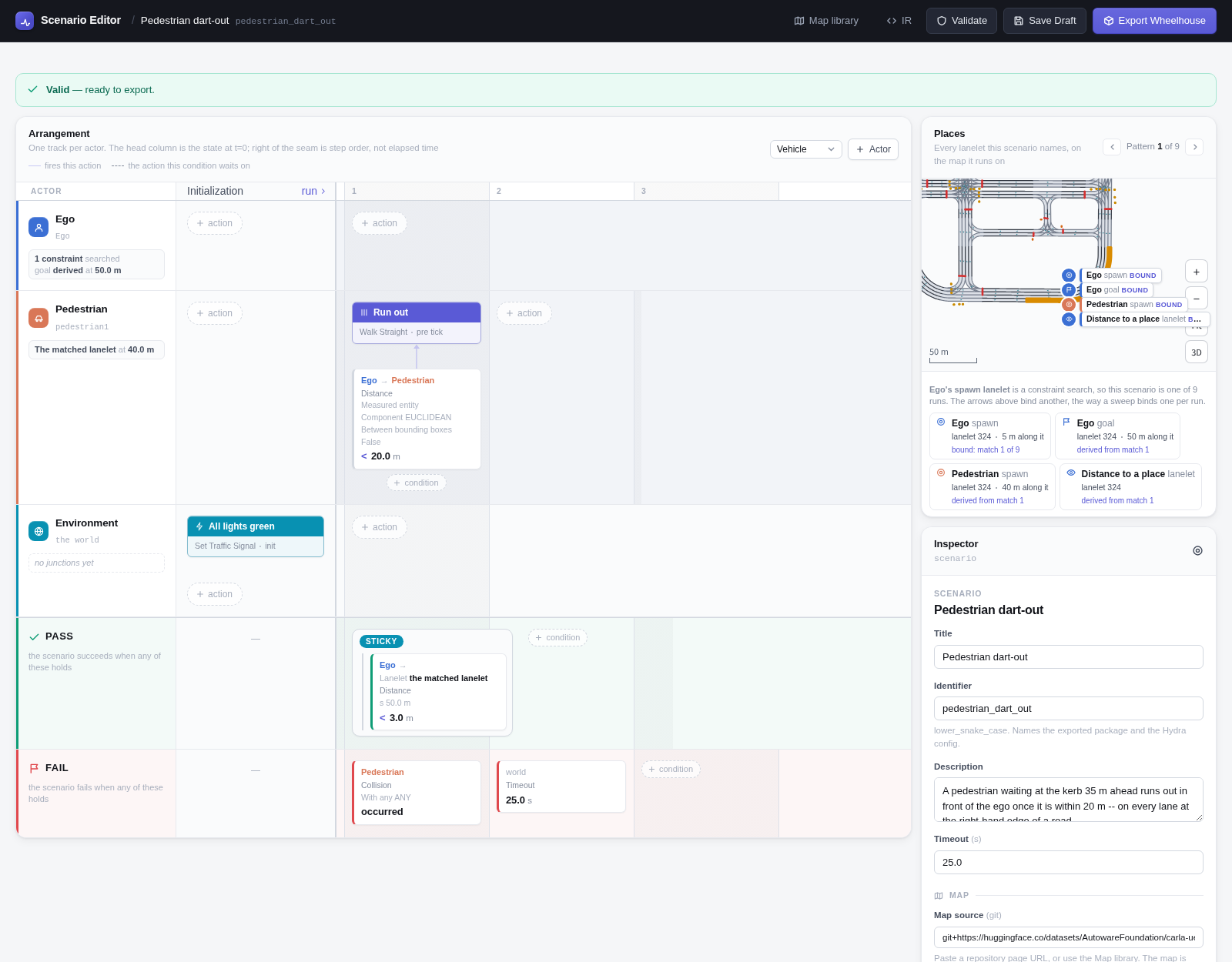
Scenario
| Ego | Constraint search: a lane with no lane on its kerb side (its left, set for the left-hand-traffic Nishi-Shinjuku; see below), not in a junction, at least 55 m long, excluding the map's lanelets with no 3D model. 5 m along it, 30 km/h. Goal from the search: 50 m along the matched lanelet, past the crossing. |
| Pedestrian | On the matched lanelet -- the ego's -- 40 m along it, 3 m from its centre on the kerb side, turned 90° to face across the lane. A walker CARLA refuses inside the kerb is tried again higher up. |
| Initialization | Every traffic light green. |
| Pedestrian, once the ego is within 20 m | Walk straight ahead at 2 m/s. With turn_back_ttc_s or turn_back_distance_m set, it turns back to the kerb when a vehicle comes that close along the road while it is still within turn_back_within_m of the kerb (see below). |
| Pass | The ego has come within 3 m of the point 50 m along its lane, 10 m past the crossing. |
| Fail | The ego hits the pedestrian, or 25 s pass. |
Parameters
| Parameter | Value |
|---|---|
| Pedestrian ahead of the ego | 35 m (at s = 40 m) |
Off the lane's centre (pedestrian_offset_m) |
3 m, on the kerb side (the sign is ignored) |
| Runs out when the ego is within | 20 m |
| Walking speed | 2 m/s |
| Passed once within 3 m of | 10 m past the crossing (s = 50 m) |
| Ego initial speed | 30 km/h |
| Timeout | 25 s |
Turn back at TTC (turn_back_ttc_s) |
off |
Turn back at distance (turn_back_distance_m) |
off |
Turn back within (turn_back_within_m) |
1 m of the kerb |
The kerb side in the sweep
The pedestrian's side is read from the map, but the sweep's has_adjacent
constraint cannot read the traffic rule: the shipped file asks for lanes with
no lane on their left, the kerb lanes of Nishi-Shinjuku, which drives on
the left. To sweep a right-hand-traffic map such as Town10HD_Opt, use a copy of
pedestrian_dart_out.yaml with value: right in that constraint.
The constraint sets include_forks: true: a turn pocket that forks off the
same lanelet as the lane beside it counts as that lane's neighbour, though
the two share no boundary and the routing graph gives neither a neighbour. On
Nishi-Shinjuku that keeps the right-turn pockets 160, 185, 213 and 556 out of
the sweep, as they lie beside 159, 184, 215 and 555. The other sweeps that
ask has_adjacent (lane_change, lane_change_fail, cut_in) leave it off: a
lane change needs the lane the routing graph can change into.
A pedestrian who turns back
By default the pedestrian runs across whatever comes. Set
scenario.turn_back_ttc_s or scenario.turn_back_distance_m and it watches
the vehicles as it goes (WalkStraightAction's turn-back options):
- When. Once a vehicle's time to collision with it, or its distance to it, is at or under the threshold. Both are measured along the road, centre to centre, as the lane-frame TTC and distance conditions measure them.
- Where it can. Up to
turn_back_within_monto the road -- a driving lane under it, measured from where it stepped off -- it turns round, walks back to half a metre behind the kerb (no further back than where it set off) and stands. One not on the road yet steps back the same way. Further out, it keeps going.
uv run scenario scenario=pedestrian_dart_out/pedestrian_dart_out map=<map> \
    scenario.turn_back_ttc_s=1.5 scenario.turn_back_within_m=1.0
Result
Town10HD_Opt, swept with value: right, the first case: the search matched lanelet 324, where the ego starts. Result: PASSED.